It is well known that Elvis couldn't help falling in love, but can you? Probably not. Let's see why.
We often hear certain phrases being used as the de facto way of expressing something, to the point that we don't even try guessing how it came to be. Falling in love is one of those. We can come to love people, objects, or places. But why 'fall' in love with them? Why not fly in love? Why not flow in love?
These verbs may sound a bit unnatural at first, but they are equally valid alternatives. From a semantic standpoint, love in its truest sense is associated with warmth and wholeness. Why then, do we fall into it? Isn't it something that uplifts us?
A quick internet search reveals that this idiom isn't exclusive to English. The French and Spanish counterparts are 'tomber amoureux' and 'caer enamorado', both of which mean falling in love. In fact, a commonly used Thai expression literally translates to 'falling in the love hole of you'. That's a pretty clear message if you ask me.
In search of a reason for this pattern, I scoured the English Stack Exchange for discussions on this topic. While there were some possible explanations in bits and pieces, I didn't find a comprehensive answer. So, here's my attempt to assemble a cohesive structure from the lego pieces that I stumbled upon.
Before we try to answer this, we first need to understand that 'falling' is not being used in a negative sense here. This is because we don't go about saying 'he fell into anger' or 'she fell into hatred' nearly as often.
If that's the case, why don't we 'fall in friendship'? Well, simply because it doesn't have that sudden, intense feeling to it, which is typical of romantic love. Most platonic friendships are gradual and develop steadily over time.
Now, to answer the actual question. The 'falling' part is not because love is some trap or pit to avoid, it is because the entire process is unexpected and involuntary, just like taking a fall. We don't plan how, when and why we'll be attracted to somebody (if you do, you probably need a therapist). People usually don't see it coming.
This is backed by Wikipedia, which says that "The term is metaphorical, emphasizing that the process, like the physical act of falling, is sudden, uncontrollable and leaves the lover in a vulnerable state". The earliest verifiable usage of this phrase is in this poem titled 'The Lover curseth the tyme when fyrst he fell in love' (off to a great start, I know).
The same logic also explains why we 'fall asleep' or 'fall sick', because we have little control over either of these sudden events. Out of curiosity, I traced back the correlation between these phrases, and their origins.
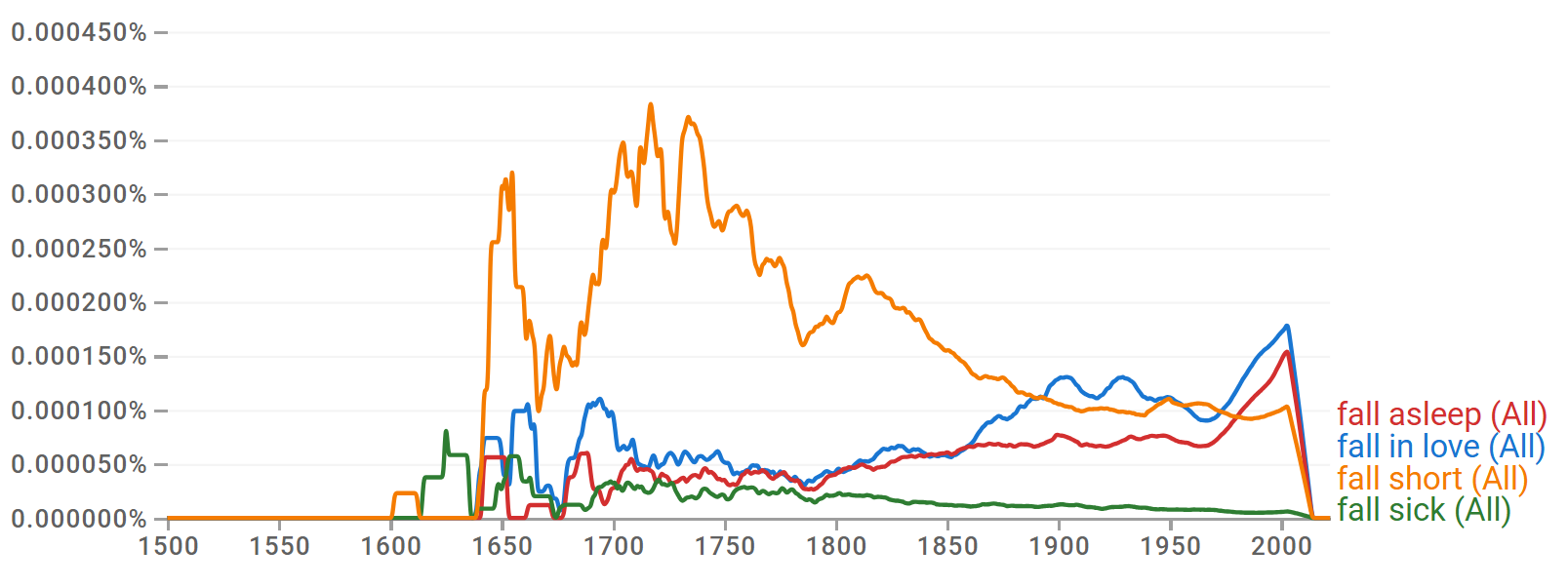
Comparison of phrases using 'fall' over the years, done using Google Ngram Viewer
It is evident from this graph that several phrases adopted the word 'fall' circa 1640, most of which are yet to fall out of fashion (no pun intended).
Okay, enough about love. What about rising to power? This choice of words looks obvious at first glance, and rightly so.
It's simple for most people. They toil and scheme their way up the ranks, to 'rise' to a position of power. This could be in the military, a monarchy, or any other organization.
If we take a brief look at our history, its pages are bloodied by wars and tyranny, even now. Almost all of those were motivated by a strong drive to impose one's will, to convert people of other religions, or to simply expand territory. The common denominator here is an insatiable thirst for power.
It is no surprise that many people with absolute authority do not abide by the expectations laid upon them. Why should they? No one can do anything about it. So, they end up indulging in hedonistic pursuits, and act selfishly in their own best interests. Finally, most end up drowning in an ocean of hubris, but that's a topic for another day.
Surely, not all leaders and rulers turn out this bad? Yes, there have been quite a few noble ones, scattered throughout the centuries, and they sure lived by Uncle Ben's philosophy. But for every Marcus, there was a Lucius, for every Augustus, a Nero, for every Piłsudski, a Hitler, for every Atatürk, a Jong Un. Regardless, the entire list is heavily skewed, and you can guess which side it leans towards.
It's really easy to act all goody-goody when you're just a pleb. The real test of character comes when even the tiniest of blemishes is amplified, and you have the ability to act on it without any repercussions. Naturally, most humans tend to give in to indulgences when there are no restraints whatsoever. This rise to power then, actually turns out to be a fall for many.
Before I digress, let me introduce you to an interesting, yet controversial concept. The Shapir-Whorf hypothesis. It basically claims that the languages we think and speak in influence how we perceive the world around us. This idea has already been shot down by many researchers, including Chomsky. The point I'm trying to make is, even if the language itself doesn't affect our cognition, the way we articulate surely does.
As far as this topic is concerned, I think it's an ironic choice of words, and maybe that's what makes it so compelling. English, with all of its quirks, has enough rabbit holes to dive into for a lifetime.
For now, I'll leave you at this crossroad of oxymorons. Is it more apt to rise in love and fall to power? You decide.